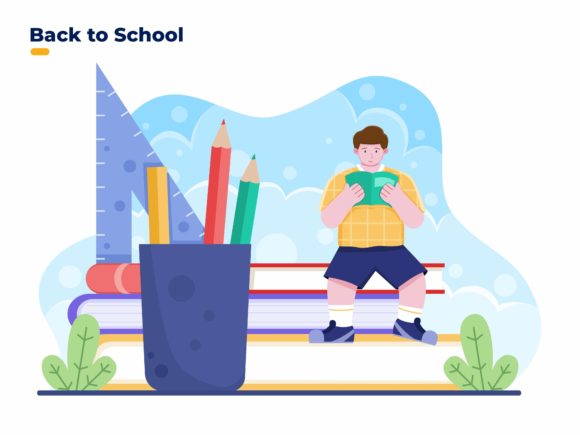
Back to School Vector Illustration: A Versatile Design Asset
Few visual themes evoke nostalgia, anticipation, and purpose quite like the back-to-school season. Back to School Vector Illustration with children sitting on a huge book surrounded by oversized stationery items captures that blend of learning and creativity in a single, scalable image. Whether you are a freelance designer, a marketing professional, or an educator looking for fresh visuals, this style of illustration offers a flexible foundation for everything from print materials to digital interfaces. Let’s explore what makes it stand out, where it works best, and how you can make the most of it without wasting time on guesswork.
What Makes This Illustration Style Distinct
The design typically features two or more children seated on an enormous open book, while large pencils, rulers, erasers, or paintbrushes frame the scene. The flat illustration approach uses bold, solid colors and minimal shading, which keeps the graphic clean and reproducible at any scale. Unlike detailed realistic art, flat vector illustrations load quickly on websites, remain legible in small postcard sizes, and adapt easily to different backgrounds.
Working in vector format means the image is resolution-independent. You can enlarge it for a banner without pixelation or shrink it for a web icon without losing clarity. The structure is modular too – if you need to reposition a child or change the book’s color, vector software lets you do that in seconds. This flexibility is one reason why Back to School Vector Illustration continues to be a go-to asset for seasonal campaigns.
Key Characteristics That Drive Value
- Scalability without loss – Vectors retain crisp edges at any size, from a business card to a storefront poster.
- Editable components – Each element (children, books, stationery) is an independent object, making customisation straightforward.
- Consistent flat style – No gradients or complex textures, so the illustration integrates easily with modern UI designs and print layouts.
- Bright, inviting palette – Typical color schemes use yellows, blues, greens, and reds that appeal to children and adults alike.
- Timeless theme – The back-to-school concept recurs annually, so the asset has a long shelf life if stored properly.
For creators who produce multiple materials each semester, having a single editable source file (like EPS or PSD) can cut design time by hours. You can change text, swap out stationery items, or even adjust the number of children without starting from scratch.
Greeting Cards and Postcards
A printed card featuring this illustration immediately signals a positive, educational tone. Use it for teacher appreciation notes, welcome cards for new students, or promotional mailers for tutoring centres. Because the vector can be exported to PDF with embedded fonts, print shops will accept it without hiccups. For postcards, keep the children large and the stationery framing clearly visible – the high contrast of flat design ensures readability even at 4×6 inches.
Banners and Posters
Retail stores, libraries, and community centres often hang vertical or horizontal banners. Back to School Vector Illustration works particularly well here because you can place the characters off-center and let the open book anchor the headline. The EPS format allows you to separate the children from the background, so you can layer them over a custom gradient or a photo – no clipping masks required. When outputting to JPG for bulk printing, select a resolution of 300 DPI to maintain sharpness on large-format materials.
Flyers and Social Media Graphics
Flat vectors are ideal for flyers because they compress well and print consistently. Use the SVG version for social media – SVG files remain small while retaining quality on retina displays. A single illustration can be reused in a Facebook post, an Instagram story, and a printed leaflet, simply by adjusting dimensions and adding text overlays. If you need to animate portions for a digital ad, the PSD file with separated layers makes it easy to import into animation tools.
Landing Pages and Web Banners
When designing a landing page for a school supply sale or an enrollment campaign, loading speed matters. SVG files are lightweight and can be styled with CSS for hover effects or animations. The flat illustration style also aligns with modern minimalist web design, reducing visual clutter. Place the children-and-book element above the fold to draw attention, then let the oversized stationery items guide the eye toward the call-to-action button.
Real-World Use Cases Worth Considering
- Independent bookstore promotion: A poster for a back-to-school reading challenge using the illustration as the hero image. The book podium becomes a natural place to overlay a tagline like “Read Big, Dream Bigger.”
- Tutoring center brochure: The children on the book convey collaboration and learning. Replace yellow stationery items with the brand’s accent color for cohesion.
- Teacher newsletter header: Export the SVG and embed it in an email. The flat colors contrast nicely with white backgrounds, and the file stays under 100 KB.
- School fundraiser flyer: Add a transparent overlay for event details. Because the original EPS file contains editable layers, you can remove or resize elements without redrawing.
Format Selection and Practical Considerations
Each format in the typical bundle – JPG, SVG, PDF, EPS, PSD – serves a distinct purpose. Here is a quick breakdown to help you choose:
- JPG: Best for quick previews and web thumbnails. Avoid using JPG for final print if the image contains sharp lines; the compression may create artifacts.
- SVG: Ideal for responsive websites, icons, and animations. It is text-based, so it can be edited in a code editor if needed. Offers infinite scalability with zero loss.
- PDF: The safest choice for sending to a commercial printer. It preserves vector data and fonts. Use this when you need to guarantee the illustration prints exactly as designed.
- EPS: A legacy format that remains widely compatible with professional design software like Adobe Illustrator and CorelDRAW. Useful if you work in a multi-team environment with older tools.
- PSD: For designers who rely on Photoshop’s layer effects or want to combine the illustration with raster textures. The PSD file retains all editable layers, so you can fine-tune adjustments nondestructively.
When downloading or purchasing the illustration, check the colour space. A vector prepared in CMYK will print more accurately than an RGB version, especially for deep blues and greens. If the file ships in RGB, you can convert it, but be aware that some bright screen colors may dull slightly in print.
Tips for Evaluating and Implementing the Illustration
Before committing to a particular Back to School Vector Illustration, look at the level of detail in the children’s poses and the stationery items. Some illustrations are purposely minimalist, while others include intricate linework on the book pages. Choose according to where you need the most visual impact – simpler designs work better for small postcards and scalable icons; more detailed ones suit posters and banners.
Check whether the file includes a white background or a transparent background. Transparent backgrounds are far more versatile, allowing you to place the illustration over any color or texture without extra masking. If the bundle only offers JPG with a solid background, consider whether your use case requires transparency, and if so, look for SVG or EPS alternatives.
Also, review the licensing terms. Some vector illustrations are royalty-free but restrict resale as standalone clip art. If you plan to use the image in merchandise (e.g., printed t-shirts or school supply packaging), ensure the license covers commercial redistribution.
Why This Illustration Style Delivers for Creators and Marketers
From a branding perspective, the combination of children and oversized stationery items communicates growth, creativity, and fun – but also structure and organisation. Flat vectors avoid the “uncanny valley” of overly realistic children and keep the mood light. This visual language works with audiences aged 20–50 because it taps into a shared cultural milestone without being childish. Parents, educators, and even office workers planning a supply drive can relate to the back-to-school theme without feeling the artwork is exclusively for kids.
Efficiency is another major benefit. Once you have the EPS or PSD master file, you can generate a complete set of materials – social media graphics, flyers, banners – in under an hour. The consistency of the flat style means you do not need to chase multiple illustrators or worry about color mismatches. Over a quarter or a semester, that saved time translates into more focus on messaging and audience engagement.
Final Thoughts
Whether you are a blogger preparing seasonal opt-in freebies, a publisher designing a reading programme poster, or a business owner creating a landing page for educational products, Back to School Vector Illustration with children on a huge book offers a solid, repeatable visual foundation. Keep the formats handy – JPG for quick drafts, SVG for web, PDF for print, EPS for editing, and PSD for fine-tuning. Evaluate the illustration’s scalability, color mode, and licensing before you start, and you will have an asset that works across multiple channels year after year.